
RULES for ROOT POSITION CHORDS
My fellow composers & performers,
French Harmony Exercises is the new name for Fundamentals of Harmony. I think it better captures the spirit of what we are trying to do. I have made 3 full-length professional shorts for the RULES FOR ROOT POSITION CHORDS. You can access it now on Skool, an online learning platform: https://www.skool.com/composition. Click on "Classroom." Signup is free.
Enjoy!
Barney (updated June 18th, 2026)
Check out some of the YouTube teaser shorts below:
How Harmony Prepares
You for Orchestration
Chapters:
0:00 Introduction
00:59 Orchestration of Melodies
5:27 Orchestration of Climaxes
11:04 Voice Leading in Harmony Exercises
14:22 Middle Voices in Harmony Exercises
18:10 Get Better at Orchestration
Hi Composers,
In this 20 minute video, I show you why harmony is the ultimate preparation for orchestration. Many of us who come from an American tradition will 'learn' orchestration through score study or analysis, and this is a vast 'gaspillage du temps' as we would say in French, as it does not actually lead to liberation.
A proper training in harmony, not intellectual, but hands-on, gives you the tools to hear the orchestration you want and manage the many, many problems that sprout up.
Orchestration is like being in charge of a vast kingdom: there are many actors and problems to deal with, and you cannot go thrashing about from problem to problem, with no clear understanding of what is important and what is less important.
In addition, you need as much as possible of the base skills, such as voice leading, and fillling in middle voices, to be on auto-pilot, so you can breathe and think clearly: this is where harmony comes in.
I recommend watching the entire video so that you can follow the thought process and evidence that I present in its entirety, but if you are pressed for time, the most important sections are "Orchestrating a Climax" and "Voice Leading in Harmony Exercises." Use the chapter markings.
I hope that you are successful in composing and orchestrating a beautfiul and highly original composition, and do not forget that no matter how good your orchestration is, you still need to get a performance.
You can leave any questions as a comment in the video itself.
-Barney (updated March 6th, 2026)
How Harmony Prepares You for Fugue
Hi Composers,
In this short video, I show the connection between harmony exercises (in the French style) and readiness for fugue. If you are banking on endless counterpoint, and you aren't working on harmony, then this video is for you.
You can leave any questions as a comment in the video itself.
-Barney (updated Feb 23rd, 2026)
Cadences for Root Position Chords
Ep 1

Ep 4

Ep 2

Ep 5

Ep 3

Ep 6

Hi everyone, I have just made a 6 part shorts series explaining the 5 essential cadences you will need for root position chords exercises. I go over the rules as well as when to use them. This will serve as the official repository of knowledge for root position chords, and I will not be releasing it publicly on Youtube. If you are in a rush, I recommend watching Ep 6, The Imperfect Authentic Cadence, as this is the one that everyone is less familiar with.
Ep 1: Perfect Authentic Cadence: Rules & Use
Ep 2: Perfect Authentic Cadence in a Bach Chorale
Ep 3: Deceptive Cadence: Rules & Use
Ep 4: Half Cadence: Rules & Use
Ep 5: Plagal Cadence: Rules & Use
Ep 6: Imperfect Authentic Cadence: Rules & Use
Do you think you are ready to take on Harmony in the French style?
You can try the exercises below.
Have a nice day,
Barney (updated Feb 14th, 2026)

Click below
for full playlist
Harmony Exercises (Season 1)
Composers & Performers,
These exercises are from Fall 2025, as part of How to Voice Root Position Chords. I have since changed the name of the program to French Harmony Exercises. I will be gradually moving the exercises and answers onto the new website: www.skool.com/composition
Click on Classroom, and go to French Harmony Exercises, to access exercises & answers
-Barney (upated August 11th, 2026)
Level One
Soprano Exercise #1

Bass Exercise #1


Soprano Exercise #2
Bass Exercise #2

Level Two
Soprano Exercise #1

Bass Exercise #1

Tutorial Guide (from Season 1)
LEVEL ONE
Episode 1: Soprano Exercise #1
Episode 2: Soprano Exercises #1 & #2
Episode 3: Soprano Exercise # 2 & Bass Exercise #1
Episode 4: not currently available
LEVEL TWO
Episode 5: Soprano Exercise #1
Episode 6: Soprano Exercise #1
Episode 7: Soprano Exercise #1
Episode 8: Soprano Exercise #1
Episode 9: Soprano Exercise #1
Episode 10: Soprano Exercise #1
Episode 11: not currently available
Once you complete an exercise to the best of your capabilities (outer voices complete, or all 4 voices completed), scroll below to find the episode that you want to get the answers for
Answer Key (from Season 1)
Bass & Soprano


Soprano Exercise #1
Bass, Tenor, Alto, Soprano
Soprano Exercise #2

Bass & Soprano
Bass Exercise #2
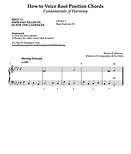
Hint: Soprano Filled In
for the Cadences
How to Voice Root Position Chords
Season 2, Ep. 2
premiered January 17th, 2026
How to Voice Root Position Chords
Season 2, Ep. 1
premiered January 9th, 2026
HW for Ep 2:
Find the best soprano
for Bass Exercise 1
from Season 2
Submission Date:
Jan 15th, 9:30pm EST
How to Voice Root Position Chords
Episode 10:
premiered December 12th
Episode Guide
1:06 Introduction
5:53 Play the Exercise
6:17 Determine the Key
6:39 Test Out the Soprano
10:03 Keep the Same Positions
18:03 Voice Across Two Sections
23:19 Get the Final Cadence

for Ep 11.
How to Voice Root Position Chords
Episode 9: Pedals on the Dominant
premiered December 5th
for Ep 10.
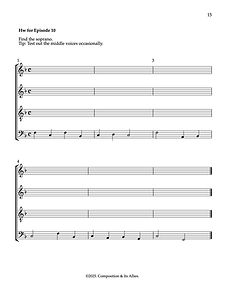
How The French Learn Harmony
Episode 8: Fill in the Middle Voices
premiered November 28th
HW for Ep 9.

How To Voice Root Position Chords
Episode 6: Listen Below the Soprano in Minor Keys
premiered November 14th
for Ep 7.

Homework Submission Due Date:
Thursday, Nov 20th, 10pm EST
Please send PDFS only. Send here:
How To Voice Root Position Chords
Episode 5: Listen Below the Soprano in Minor Keys
premiered November 7th
Homework for Episode 6

How To Voice Root Position Chords
Episode 3: Listen Above the Bass in Minor Keys
premiered September 26th
Episode Guide
coming shortly
Homework
Please submit your homework in PDF format before Sunday, October 5th at 10 pm. Please note, I will not give individual corrections, but I will correct the homework on the next livestream, and record it. You will also receive a link to the Zoom Live Session.
How To Voice Root Position Chords
Episode 2: Listen Below the Soprano in Minor Keys
premiered September 12th
Episode Guide
0:00 Introduction
3:50 Homework Answers pt 1
15:24 Homework Answers pt 2
37:06 Homework for Episode 3
Homework
Please submit your homework in PDF format before September 19th, 6pm. Please note, I will not give individual corrections, but I will correct the homework on the next livestream, and record it. You will also receive a link to the Zoom Live Session.

How To Voice Root Position Chords
Lesson 1: Listen Below the Soprano in Minor Keys
premiered August 29th
Episode Guide
0:00 Introduction
2:45 Figure Out the Key
5:25 Make a Chart of the Available Chords
7:56 Figure Out the Cadences
9:43 Perfect Authentic Cadences
11:18 Half Cadences
12:34 Deceptive Cadences
13:53 Plagal Cadence
14:09 What are the Cadences?
16:36 Fill in What We Know
18:14 Bass Too Close to Soprano
19:41 Minimum Distance of Bass to Soprano
20:17 Phrases
21:49 Test Out The Chords
24:37 Revise the Octave of the Bass
26:25 Realize the First Phrase
35:14 Homework 1
40:01 Homework 2
Homework
Please submit your homework in PDF format before September 6th, 6pm. Please note, I will not give individual corrections, but I will correct the homework on the next livestream, and record it.
Resources
Rules for Root Position Chords
How to Properly Voice a
Deceptive Cadence
